


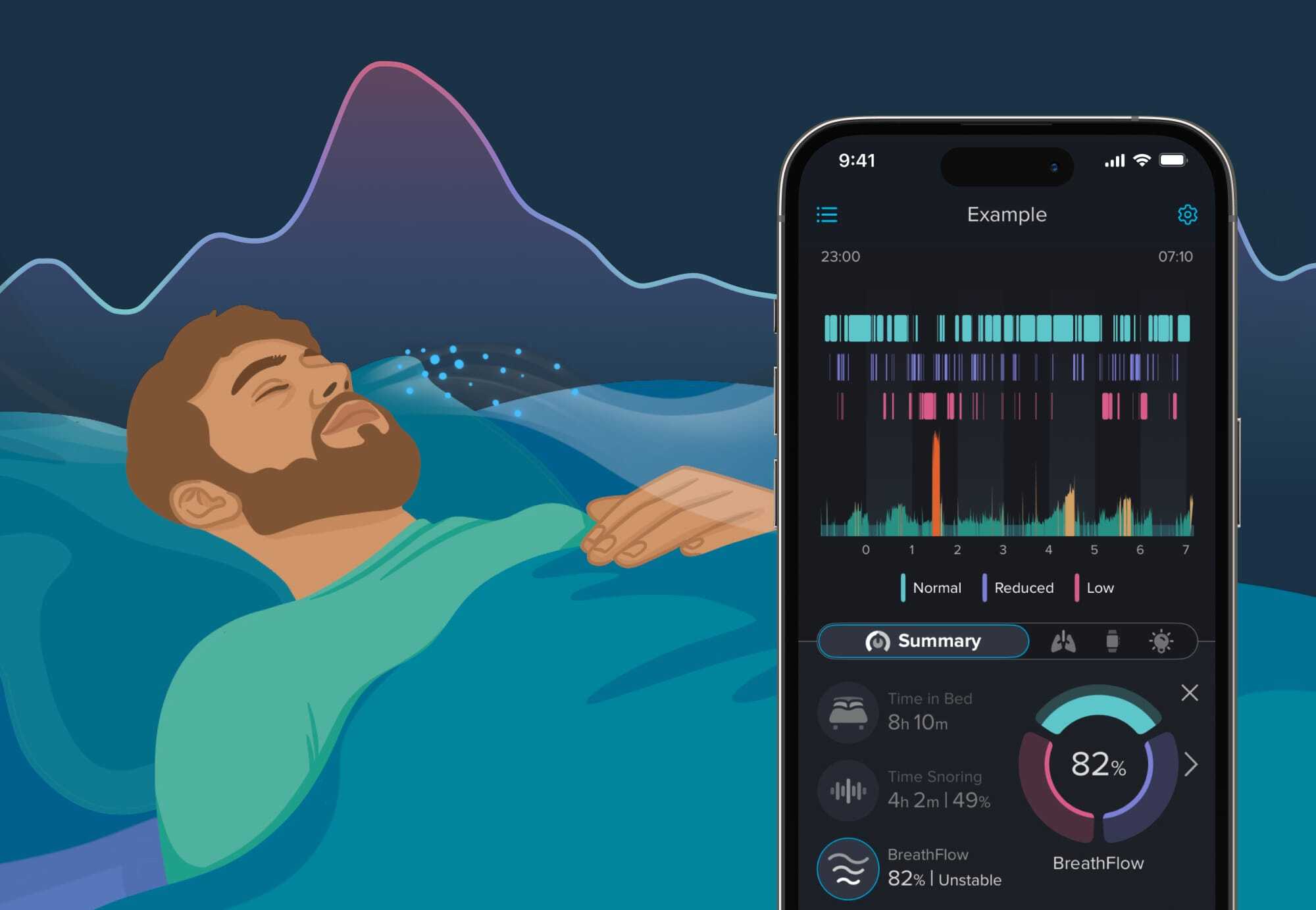

London, UK. 25th November 2025 SnoreLab, the world’s leading snoring app, announces the launch of BreathFlow, a new feature that measures breathing stability during sleep using only a smartphone. Developed by Reviva Softworks, BreathFlow is a wellness score highly correlated with clinical measures of sleep-disordered breathing and is calculated using acoustic signals. The feature launches first on iOS, with Android to follow shortly.
Sleep-disordered breathing is estimated to affect 25% of UK adults [source]. Despite its prevalence, obstructive sleep apnoea (OSA) is still estimated to go undiagnosed in 80–90% of cases [source], leaving countless people unaware of their condition.
The BreathFlow model was developed using 380 nights of gold-standard sleep lab reference data, meaning it was trained against the most reliable clinical benchmarks. Unlike other consumer sleep trackers and wearables, BreathFlow is designed to capture both subtle and strong disruptions in breathing, grading them as ‘Reduced’ or ‘Low’ stability. Its scoring system was designed so that stronger disruptions have a greater impact on the BreathFlow score than milder ones. The score is presented as a positive scale with an upper value of 100%. In validation, BreathFlow scores below 90% were highly correlated with sleep-disordered breathing.
To deliver this analysis from a smartphone, the SnoreLab team developed a lightweight model that predicts BreathFlow from audio signals using a proprietary methodology that combines acoustic imaging with machine learning. The model runs entirely on the user’s device, without requiring an internet connection, ensuring privacy while making advanced breathing insights widely accessible.
Obstructive sleep apnoea (OSA) is estimated to be undiagnosed in 80-90% of cases [source], partly due to misconceptions around the condition. One common belief is that OSA only affects “overweight men,” and another is that it is defined solely by “long gaps in breathing.” These simplified characterisations only capture a fraction of the people who have the condition.
In reality, OSA can affect anyone regardless of sex or body type and can be triggered by factors such as facial anatomy, ageing and allergies. Often, people may be breathing audibly without distinctive gaps, yet their airway is partially obstructed. This can result in falling oxygen levels and contribute to symptoms such as daytime tiredness.
These acoustically-based wellness metrics cannot objectively identify sleep-disordered breathing in the same way that clinical-standard sleep studies do. However, BreathFlow is specifically designed to be more sensitive for subtle disruptions, compared to other wearables and consumer sleep devices.
Whilst the novel BreathFlow scoring system has its distinct advantages, the SnoreLab team also recognised the importance of a scoring metric that was better aligned with widely used consumer sleep technologies such as the Apple Watch Breathing Disturbance Index. To support this, thousands of SnoreLab users opted to share their Apple Watch BDI scores. This facilitated the training of a separate SnoreLab BDI model, which demonstrated a strong correlation of 0.92 with the Apple Watch over 1200 validation nights.
SnoreLab’s two different but related metrics, BreathFlow and BDI, are not diagnostic measures of sleep-disordered breathing. However, these convenient scores provide signals that are highly correlated with clinical measures and empower users to track nightly variations in breathing stability using only a smartphone.
SnoreLab is widely recommended by healthcare professionals, who value it as a simple, accessible tool that provides reliable metrics to support consultations. One of the app’s key advantages is its detailed audio recordings and visualisations, allowing users to both see and hear their breathing during sleep.
Jules Goldberg, Founder of Reviva Softworks and creator of SnoreLab, explains:
“BreathFlow is SnoreLab’s biggest ever update, and we are very excited to give our users these extra layers of insight. We have put enormous effort into creating a meaningful wellness score that addresses the limitations of other systems, and we are incredibly proud of the results we have achieved using our unique methods.”
Professor Thomas Penzel, Director of Advanced Sleep Research (ASR), who facilitated the external lab study, added:
“BreathFlow is an innovative approach to scoring sleep and I have been very impressed by the results the SnoreLab team have achieved.”
SnoreLab’s BreathFlow is now available to try on iOS, with Android coming soon.


